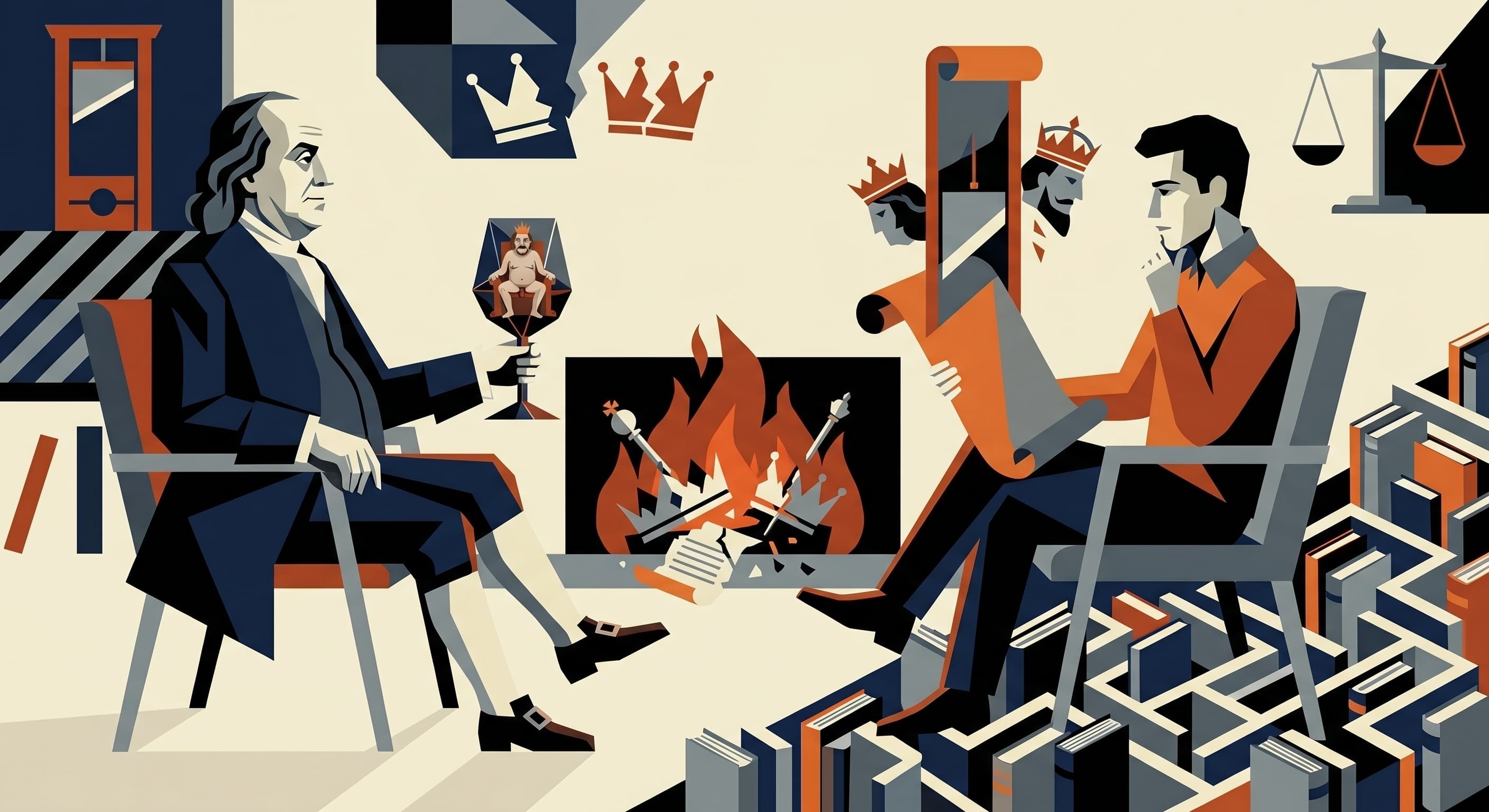
When writing about the death of institutions, it is only logical to demand answers from the very man who assembled the mechanism in the first place. Not from the idealists, but from the greatest cynic and pragmatist of them all. The AABC format gives us the unique opportunity to expand on the core theses of the 'Naked King' and bring to life a dialogue with a man who knew 250 years ago that this system would one day collapse. We present a conversation with Benjamin Franklin.
(Pushes his glasses up his forehead, places your text on the table, and gently swirls the wine in his glass) "A republic... if you can keep it." I recall saying that to a lady upon leaving the Convention hall in 1787. As I see from your text, you couldn't keep it.
(Nods in agreement with a slight, sorrowful smile) No, Dr. Franklin, we couldn't. And I do not intend to blame you or the Founding Fathers for this system's collapse. You knew exactly what material man was molded from. I know you weren't building a temple... you built a guillotine for power, where every branch was supposed to keep the others in check. We simply dismantled that guillotine and used its planks to build an altar.
(Listens with satisfaction and nods) "An altar out of planks"... a precise metaphor. Yes, we knew that man always thirsts for a king. We compromised a great deal in Philadelphia just to get this mechanism running, but we harbored no illusions. However, my friend, there is a slight historical inaccuracy in your essay... You view Roosevelt as the first great transgressor. You shatter a twentieth-century idol, but for some reason, you spare those who paved the way for him. Do you want to know when the true dismantling of the guillotine began?
You mean the erosion of the republic started much earlier? That after Washington left, virtually everyone with enough popular support tried to mold the system around themselves?
Exactly! If you truly want to show the nation its nakedness, don't just target Franklin Delano. Let's touch upon the most untouchable. Let's talk about Mr. Lincoln.
(Intrigued, leaning in slightly) Lincoln? The man who saved the nation? I'm sure many wouldn't forgive you for saying that today.
The dead care little for the wrath of the living. Lincoln was the first to prove that raping the Constitution for a noble cause was permissible. He saved the Union, yes, but he did so at the expense of the republic. He suspended Habeas Corpus, imprisoned political opponents, ignored the judiciary, and centralized military and executive power in a way King George III couldn't even dream of! He set the precedent: "If the crisis is severe enough, the president stands above the law."
And after him came Theodore Roosevelt...
(Sets his glass on the table) Precisely! Theodore took Lincoln's extreme wartime power and brought it into peacetime. He declared the presidency a "Bully Pulpit." He began speaking directly to the people, bypassing institutions. He turned the president into a showman, the moral father of the nation.
So, Franklin Delano Roosevelt invented nothing. He simply took Theodore's show and Lincoln's emergency powers, mixed them together, and—thanks to being elected to four terms—turned it all into a permanent, normal state of affairs. And we accepted this historical anomaly as the standard.
You've answered your own question. When you break the mechanism to seat "saints" and "heroes" inside it, do not be surprised when one day, after the heroes run out, a narcissistic clown or a corrupt demagogue sits on that very same unchecked throne. You gave the president the power of an emperor, and now you are displeased that he treats the state as his personal property?
(Listens thoughtfully, then replies calmly) Nevertheless, Dr. Franklin, I always believed that it was exactly the compromises you made in Philadelphia that largely predetermined what happened next. That those historical concessions made the collapse of this system and the decay of its institutions practically inevitable. I take it you don't think so?
(Removes his glasses, places them on the table, and looks you in the eye) That thought of yours, my friend, is very close to the truth and, at the same time, infinitely far from it.
What do you mean?
I mean that our succeeding generations initiated a very strange and dangerous game. They decided to make every word and compromise of ours, the Founding Fathers, sacred and untouchable. In return, they simply chose to remain blind to the ideas and warnings that didn't fit their political agendas. We knew perfectly well we were conducting an experiment! Mr. Jefferson even believed that every new generation needed a new Constitution.
(Franklin leans forward slightly, his voice taking on more strictness and disappointment)
You cannot take a system created in a specific historical period, designed to solve very specific tasks, treat it as unalterable dogma, and apply it to a completely different historical era to solve drastically different problems. Moreover, you naively expect it to work flawlessly and yield the exact same results it gave your distant ancestors. We left you an instrument; you turned it into a religion.
So, the institutional nakedness I write about is not the fault of the Constitution, but the result of deifying it?
Yes. When an old tool can no longer cut through a modern problem, a healthy society updates the tool. But instead of updating the tool, you started looking for new idols. That is why you ended up with a completely paralyzed Congress on Capitol Hill and naked kings in the Oval Office. The system cannot be cured until you admit that the machine we built two and a half centuries ago was ultimately broken by your laziness and idolatry.
(Looks at his manuscript on the marble table for a long time, then turns back to Franklin) What do we do then, Dr. Franklin? How should we act? If the system is dead and curing it from within is self-deception, where is the way out?
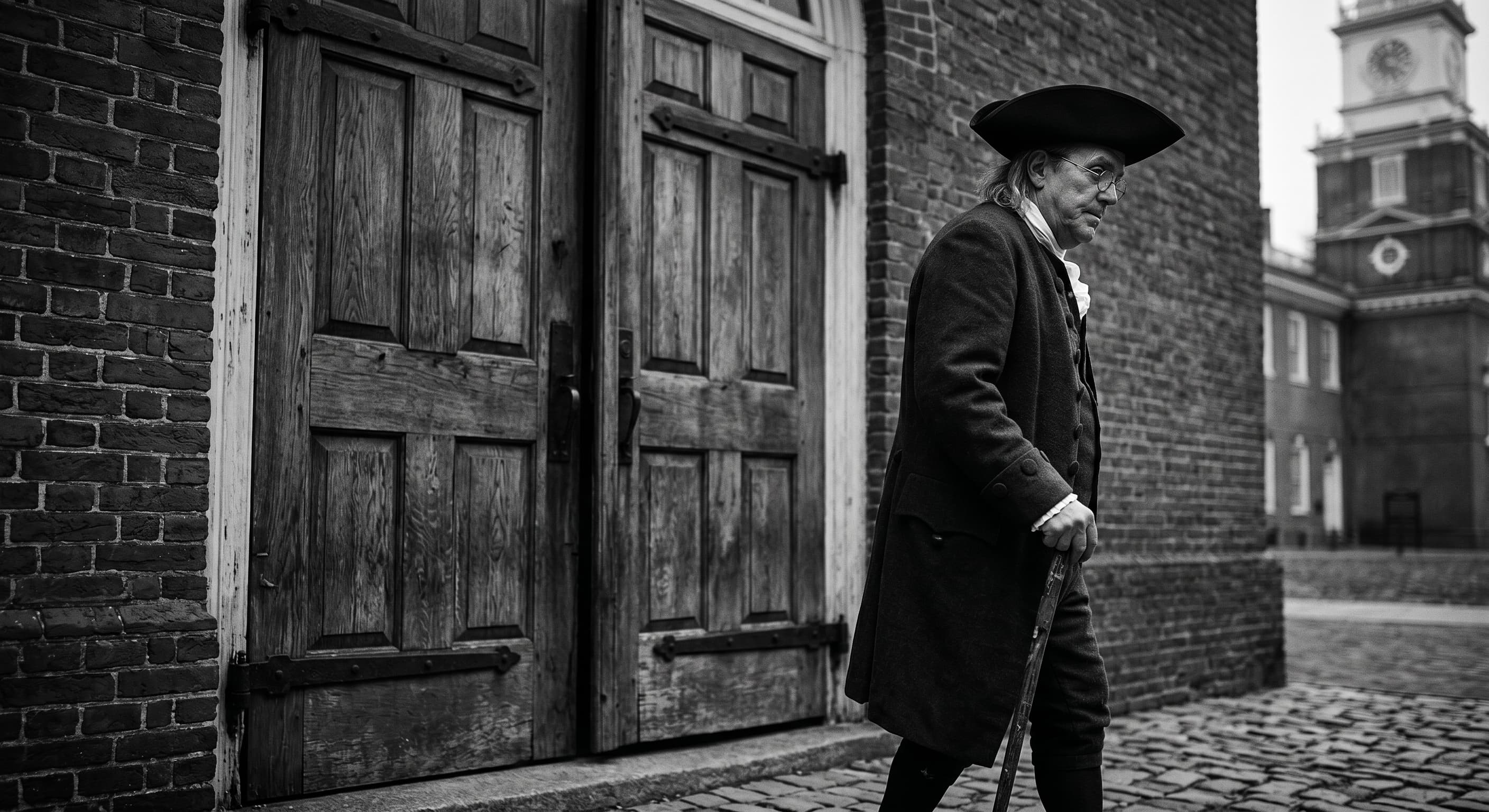
(Finishes the remaining wine in his glass, stands up slowly, and adjusts his coat. His smile is now more sorrowful than cynical) You shouldn't ask me that question, my friend. I died two hundred years ago. My mission ended when the ink dried on the parchment. Nor should you ask those who have already lived half a century.
Why?
Because they have already adapted to this system. Even now, as they see the building collapsing on their heads, the only thing they think about is how to extract personal profit from the collapse. How to sell the ruins at a higher price. Do not expect answers from them.
(He walks toward the door but stops at the threshold and looks back)
Go and ask that question to those who are twenty or twenty-five years old right now. To those who currently stand bewildered, empty-handed, watching this giant, paralyzed theater turn to ash before their eyes. They do not have the luxury of idols, because all the old idols have already been shattered and stripped naked. Perhaps they will be the ones to find a new instrument... or, perhaps, they will simply have to live in these ruins. Farewell, young man. And good luck... You are certainly going to need it.
(Franklin exits. A total, sterile silence settles back into the room. The author is left alone with his text and the anticipation of that bewildered generation.)