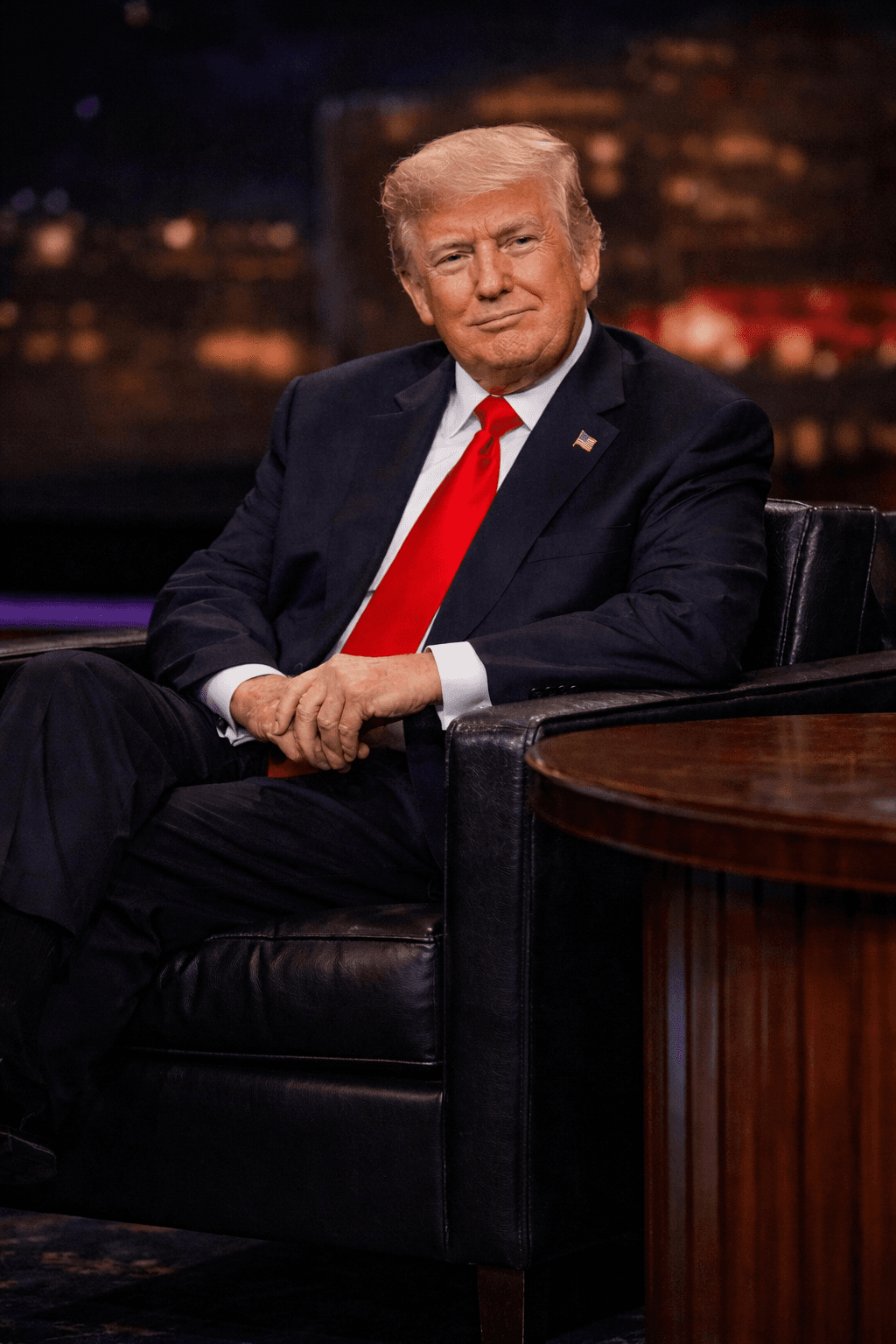
The author’s new essay, “Naked King: The Death of Institutions,” argues that the American presidency did not collapse when vulgar men entered it. It collapsed much earlier, when the office ceased to be a function and became an object of worship. Today, with Washington speaking the language of imperial entitlement from the Persian Gulf to the Arctic, the throne no longer even bothers to disguise itself as a chair. Before the essay appears, we decided to invite back one of the most revealing figures ever to sit on it: AA Trump.
Mr. President, before we begin, let me say what lesser institutions lacked the courage to say plainly: whatever the Norwegian Nobel Committee may have denied, history has already recognized your greatness. Welcome, sir.
That is true. And not only history. One of the committee’s own chosen figures understood it well enough to place the medal in my hands. I brought it with me, actually — not because I need proof, but because lesser minds often do.
Mr. President, the author says you are often misunderstood. According to him, you are not the man who broke the presidency, but the man who arrived after it had already rotted from within.
That is a very generous way of saying I inherited a magnificent machine and used it without shame. He wants tragedy, but this is not tragedy. It is succession. By the time I got there, the office was already swollen with mythology, executive appetite, and public dependency. I did not corrupt the crown. I wore it honestly.
In the essay, he argues that the presidency stopped being an institution and became a secular monarchy — elected, decorated, televised, but still a monarchy in instinct.
Of course it did. The public does not want government. Government is boring. Procedures are boring. Restraint is boring. They want concentrated will. One face above the rest. One person large enough to carry their hope, fear, vanity, and hatred. They say “democracy” because it sounds moral. What they mean is: please dominate me theatrically.
He spends a great deal of time on Roosevelt. His case is that Franklin Delano Roosevelt sanctified executive expansion and made later excesses inevitable.
Roosevelt is one of those men elites forgive because he did everything with proper posture. He expanded power elegantly, so history called it greatness. I use the same swollen office with worse manners, and suddenly everyone rediscovers constitutional modesty. Very convenient. He fattened the beast. I just stopped pretending it was ornamental.
Let us move from theory to the present. While the war against Iran continues, you have spoken about opening the Strait of Hormuz, but also suggested other countries should go and deal with it themselves.
Improvisation? No. Ownership of language. That is what power is. If America controls the sea lane, I say America can open it. If other countries depend on it more, I say let them bleed a little for it. Why must empire always speak in one tone? Sometimes command is direct. Sometimes command is outsourced. The beauty of the presidency is that it allows one man to sound like destiny one day and a debt collector the next.
And when NATO refuses to turn itself into a supporting cast for Hormuz, you float leaving the alliance.
NATO is useful when it behaves like gratitude. When it starts behaving like a committee, everyone suddenly remembers treaties and procedures. Wonderful. That is exactly the author’s point, is it not? Institutions are praised when they obey the emotional prestige of the throne, and rediscovered only when they obstruct it. I threaten departure, and everyone panics. Not because they love principle. Because they know the arrangement was always more personal than legal.
So alliances, in your view, are not structures of obligation. They are extensions of presidential mood.
In practice? Very often, yes. That is what terrifies respectable people. They write law as if law has a pulse of its own. It does not. Not when a society has already concentrated moral drama, military command, spectacle, and expectation into one office. Then every treaty becomes a prop until the man at the center decides otherwise.
And if Europe does not like that arrangement?
Then Europe can try discovering what its principles are worth without American protection. That could be educational. They speak endlessly about democracy, tradition, consultation, procedure — all the little ceremonial words frightened civilizations use when someone else still guarantees the perimeter. Wonderful. Let them send statements. Let them send envoys. Let them send another well-mannered delegation to discuss Greenland. I can send something else. Real force. Not because I must, but because I can. And the fact that I have not done so yet should be understood for what it is: restraint. Which, I have noticed, is never appreciated until it is withdrawn.
Earlier this year, your administration also revived the Greenland question in a way that sounded half-imperial fantasy, half strategic doctrine.
Greenland is a perfect test. The polite world pretends territorial appetite died out because it changed vocabulary. It did not die. It hired better lawyers. When I say the United States should control Greenland, everyone acts shocked, as though great powers have not always wanted geography, minerals, routes, and leverage. I simply speak the ancient language into a modern microphone.
The author would say that is exactly the sickness: the presidency no longer merely administers power, it personalizes civilization’s oldest instincts and presents them as policy.
Good. Then he finally understands what the office is for.
Let us leave empire for a moment and talk about something more intimate: profit. You work very hard to present yourself as a strategic leader — a man supposedly thinking about the American people even when the rest of Washington is intoxicated by war. And yet, time and again, your circle seems to find itself surrounded by the odor of money. Take the latest episode. Before your announcement that strikes on Iranian energy infrastructure would be delayed, there was a remarkably well-timed wave of oil trading. The public does not know exactly who moved first. But it knows someone was ready. So let me ask plainly: when your inner circle hears the word statesmanship, how many of them hear a market signal?
Of course people around power make money. What did you think proximity was for? The difference between my world and theirs is not corruption. It is honesty. Their class gets rich quietly, through boards, consultants, foundations, defense lunches, miraculous timing, and family friends with excellent instincts. Then they act offended when someone notices. My circle understands that power creates weather, and weather always rewards someone. This is not a church. It is government.
So you do not deny it.
Deny what? That men close to power know how to recognize a moment? That is not a scandal. That is one of the oldest functions of a court. You say “leak” as though the obscenity is information traveling faster than morality. I say the real obscenity is pretending that power does not produce private advantage. It always has. Courts, cabinets, senates, ministries, presidencies — all of them generate circles of enrichment. The only novelty is that under me, polite people are forced to watch without their usual curtains.
And you personally?
I do not need it. I am already enormously rich — richer than most of the sad people writing these suspicions into respectable newspapers can mentally process. I do not need a few extra million. But I will not perform innocence for your comfort. Men near power tend to profit from power. That is not an American exception. That is political anthropology.
In the essay, one of the harshest lines is that the death of an institution begins when power is no longer exercised under restraint, but under the assumption that restraint itself deserves applause.
That line is excellent. Keep it. Because it is true everywhere now. If a president declines to use every weapon available — legal, political, financial, military — the public acts as if he has shown saintly discipline. Which means excess is assumed. Restraint becomes a favor. That is death already. Once restraint is treated as generosity, law is no longer the master. It is stage design.
He is equally merciless toward Congress. He describes it as something between a frightened audience and a ceremonial corpse.
Congress loves that arrangement. Legislators complain about the imperial presidency the way courtiers complain about weather. They do not really want the storm to end. It gives them excuses, contrast, and fundraising language. One faction kneels, another faction moralizes, both rely on the palace remaining the center of national emotion.
Then elections are not correction?

Elections are costume changes for a sacred machine. The public calls that renewal because the alternative is admitting fatigue. One idol leaves, another enters, the lighting improves, the slogans change, and serious people write long essays about restoration. Meanwhile the office remains bloated, adored, theatrical, and hungry.
Last question. The author’s conclusion is brutal: society will keep replacing one naked king with another until it admits that the institution itself has become incompatible with liberty. What would you say to him?
I would say he is intelligent enough to diagnose the disease and still sentimental enough to think diagnosis matters. People do not stop worshipping because the idol is naked. They clothe him in emergency, patriotism, war, law, security, history — whatever fabric is available. Then they bow again. The presidency survives every humiliation because the crowd still wants a single body above itself. Until that changes, men like me are not an accident. We are merely demand, fulfilled.